

INTRODUCTION
Ngaio Farm has an interesting history. It began its European life as a horticultural farm. The first record of a lease from the Crown is in July 1896 when the leaseholder was Martha Castle and the rent was 2 pounds 8 shillings and 10 pence. Subsequent leaseholders and owners were:
June 1904 Bertie John Goodall and Leonard William Goodall
August 1909 Robert John Bradley and Lionel Alexander Bradley
July 1911 Lionel Alexander Bradley. It is thought that the farmhouse was built at this time.
May 1915 Francis Oscar Norman Drummond. In August 1915 land was taken for the Kaiteriteri – Sandy Bay Road.
December 1917 George William Tutbury
August 1923 Reginald Leonard Clarence (“Rackety”) Drummond. He planted pine trees on the edge of the beach, which were misshapen at their tops because the cows ate some of the shoots.
November 1926 Henry Manoy and Lionel Manoy.
March 1938 Title made freehold for 127 pounds 10s and 7d
May 1941 B B Jones and Harold James Robertson for 930 pounds.
- Some of the land was subdivided, which resulted in
- Lot 1 H J Robertson
- Lot 2 Gwynneth Oliver (daughter of B B Jones)
- Lot 3 Jean Wells (daughter of B B Jones)
- Lot 4 Noel Jones (son of B B Jones)
- Lot 5 J N Dalhoff
1961 The front right hand corner of Lot 1 was subdivided off and the balance of Lot 1 was transferred to Elizabeth McKenzie
- Following the death of Harold Robertson, the balance of Lot 1 was transferred to Elizabeth McKenzie.
1982 or 83 Sale of J N Dalhoff’s interests to the Baigent Family.
Other events:
Scows used to moor at the mouth of the stream at high tide to be loaded with crops. One of these, the cutter “Gannet” whose photo is shown below, was wrecked on the beach on 28 April 1918, with a load of water melon bound for the factory of S Kirkpatrick & Co in Nelson. There were water melon spread all along the beach. The “Gannet” is described in “The History of Port Nelson” by Ruth Allan (Whitcombe & Tombs 1952) as:
“25 tons, built in Auckland 1881, registered Auckland. Came to Nelson some years later and converted to ketch by Rickets. Wrecked Ngaio Bay 28 April 1918.”
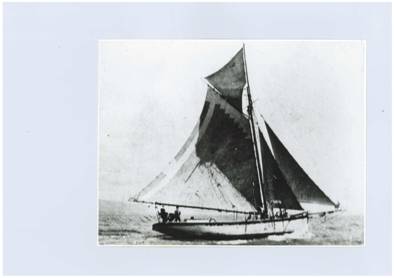
J J Rickets was a boatbuilder and is recorded in the same book as the builder of “Anatuero” a cutter of 10 tons built about 1890 at Sandy Bay; “Transit” a ketch of 21 tons, 49 feet, built at Marahau in 1885; and “Comet” a ketch of 22 tons, 48 feet, built at Torrent Bay in 1883.
Henry and Lionel Manoy also bought property at Astrolabe in 1928 – 4 acres at what is now named Appletree Bay. In “Abel Tasman National Park – A handbook for visitors” (R W Stiles 1962), Emily Host notes that the Manoys bought a general store in Motueka and that the business expanded until the family also owned a butter factory, flour factory, flour mill and a hop garden at Ngaio Bay.
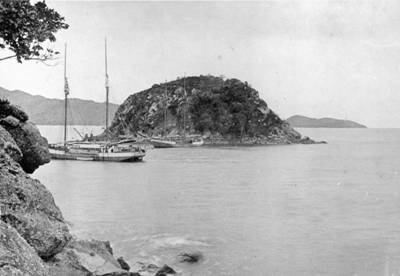
Stone was taken from Ngaio Island to build the mole at the entrance to Nelson harbour in 1906. See photo below.
Electricity came to Kaiteriteri in 1952 and to Ngaio Bay in 1953 when the second series of houses were built. The Oliver house was built, together with the first Wells house as a “two unit” house. This configuration was used because at that time there were still wartime restrictions which limited the size of holiday homes to 900 square feet. The Oliver house comprised four bedrooms and a bathroom, and the Wells house, close by, but on the adjoining section, comprised the kitchen, dining and sitting rooms. In 2002 it was agreed to discontinue the joint arrangement because of the size of the extended family. The Oliver house was extended and renovated. The Wells house was replaced by the current house.
The floodgates were built quite early on and Mr Dalhoff tried unsuccessfully to use them after he purchased his land in 1952.
The old tobacco kiln (see photo) was brought down by a falling tree in 1968.
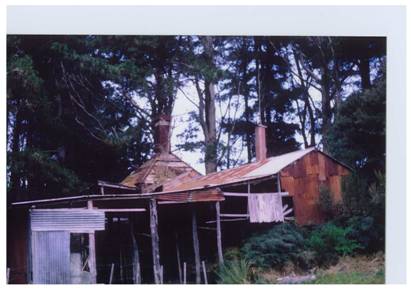
Lennie Gardiner used to stay in the two old farm workers cottages, which I also remember staying in when the Hyatts were farming the property. These cottages were close to the drive near the boundary between Lots 4 and 5. Lennie started building a cottage at Tower Bay but this was never completed.
The research of the ownership of property in Ngaio Bay and the photos were kindly provided by Scobie McKenzie. I am also grateful for contributions from Helen Hyatt who, with her husband Austin Hyatt, was farming Ngaio Farm when I first visited Ngaio Bay in 1946.